

Esq William Orde
William Orde was born 16 Jun 1735 Norham, Northumberland.
Son of John Orde and Mary Ward (1st Wife B:1703-D:1735), he was one of five children.
Mary Orde 1745-1790 (Half Sibling Fathers Side)
Thomas Orde 1746–1807 (Half Sibling Fathers Side)
Anne Orde 1747–1825 (Half Sibling Fathers Side)
John Orde 1751–1824 (Half Sibling Fathers Side)
Married:
William married his cousin Ann Ward on 12 Jun 1771
They had four children:
John Orde 1772–1858 (Major) (Buried North Sunderland)
William Orde 1773–1842 (Law Barrister)
Charles Ward Orde 1776–1810 (Major of the 9th Regiment of Light Dragoons)
Thomas Orde 1779–1805 (Captain in the royal Navy) (Antigua, West Indies)
Died:
11 Feb 1814 of Nunnykirk and East Orde.
He is buried at St. Mary the Virgin Churchyard, Morpeth.
Nunnykirk Hall
In 1536 the Nunnykirk estate, including a tower, was owned by the abbots of Newminster Abbey but fell to the Crown on the Dissolution of the Monasteries. In 1610 it was granted by the Crown to Sir Ralph Grey. Grey later sold it to
the Ward family of Morpeth who built a manor house.
In 1771 Ann Ward, the heiress of the Nunnykirk estate married William Orde, (the half brother of Admiral Sir John Orde). Their son William Orde, Jr. (1774-1843) rebuilt the house in a grand style designed by architect John Dobson in
1825.
William Orde, Jr. established a racing stud at Nunnykirk and both he and his nephew and heir Charles William Orde (1810-1875) enjoyed considerable success as breeders. Their most successful horses were Beeswing, Nunnykirk (winner of
the 2000 Guineas), and Newminster (winner of the St. Leger 1851).
Source: Wikipedia
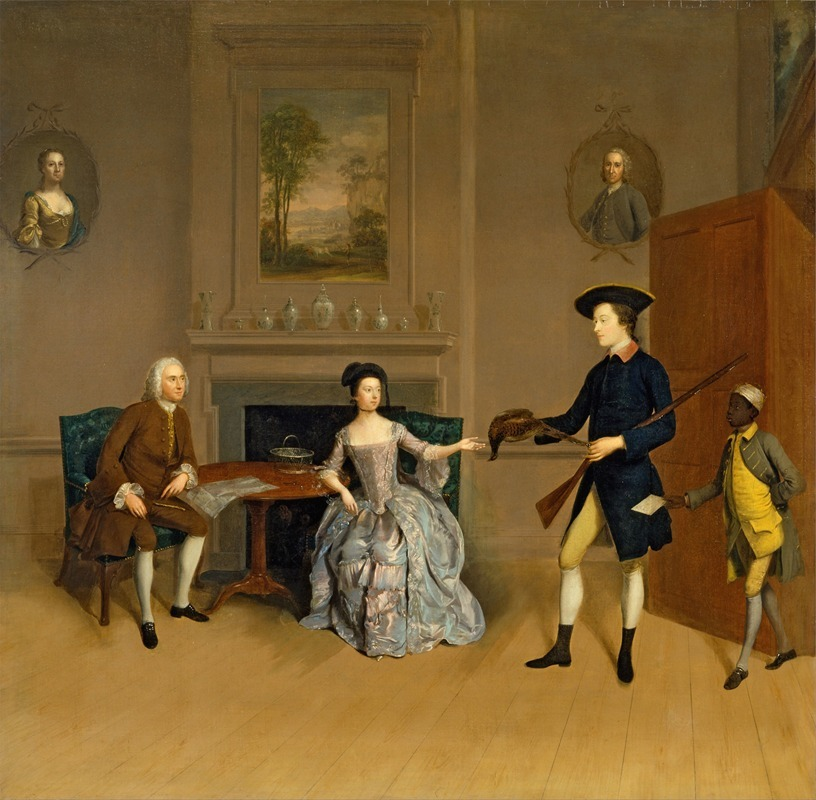
John Orde, His Wife Anne, And His Eldest Son William (1754 - 1756)
License: All public domain files can be freely used for personal and commercial projects.
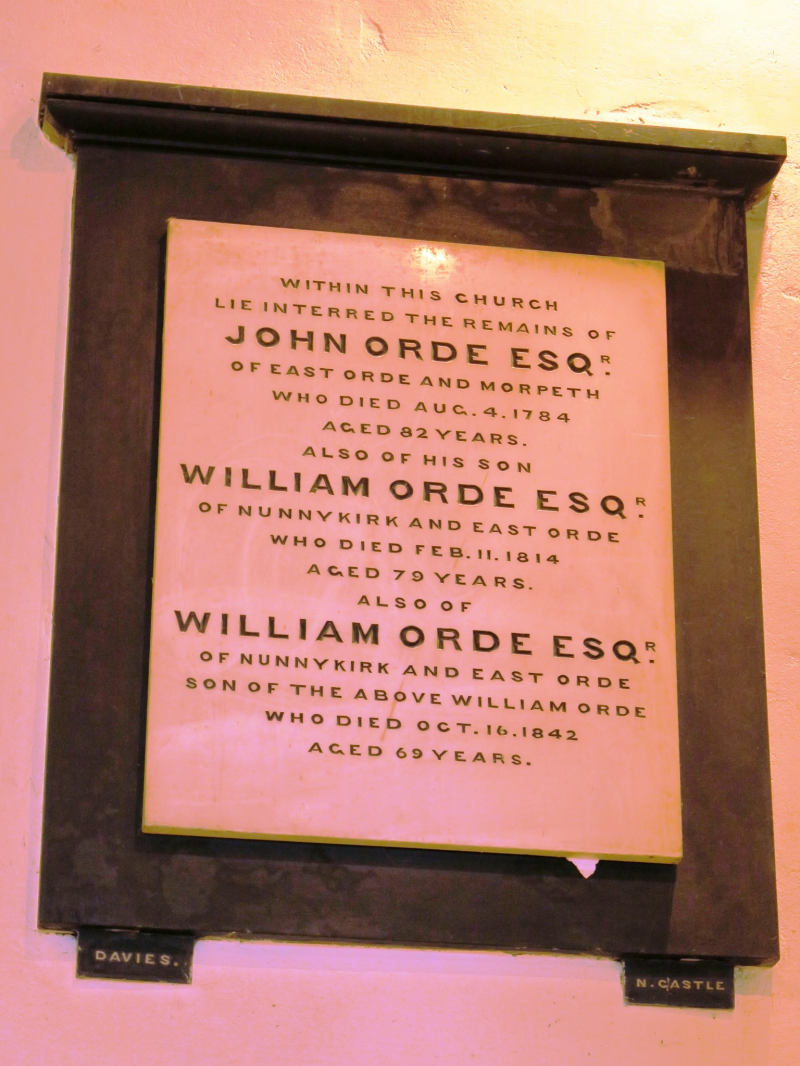
Photo Source: Thomas hunter Brown on Find a Grave

Picture Source: Pinterest
Beeswing (Race Horse)
Beeswing's dam was an unnamed daughter of Ardrossan out of the Whitworth mare Lady Eliza. Beeswing's mother ran only once, as a two-year-old, and suffered an injury to her stifle, which reportedly left her a cripple for the rest of her life. It did not seem to affect her as a broodmare, for besides Beeswing, she produced Tomboy, a Jerry colt who captured the Doncaster Cup.
Beeswing herself was a small, somewhat delicate filly, topping out at just over fifteen hands when she matured. Foaled in 1833, she was bred by William Orde, a former M.P., who inherited an estate at Nunnykirk, just west of Morpeth, in Northumberland, upon the death of his elder brother. The turf writer The Druid observed that, "With all his turf lore, Mr. Orde had never learnt that bone and muscle must originally go in at the mouth. She [Beeswing] was a well advanced yearling before she rubbed her nose against an oat. She was light-boned, "...owing, in a great measure, to her having been badly kept as a foal." But what the filly lacked in size she more than made up for in heart and courage. She "...was a tremendous kicker in her stall, but showed no vice whatever at the post. She pulled very hard at first, but was, nevertheless, a most delightful mare to ride."
Queen of the Turf
Beeswing's first outing as a juvenile was at Newcastle, where she ran unplaced in the Tyro Stakes. She followed that poor start with a win in the Champagne Stakes at Doncaster, beating the colts St. Lawrence and Jericho, and then ran in a sweep at Richmond, which she also won. Those were her only races at age two.
As a three-year-old, Beeswing won both the Cup and the St. Leger at Newcastle, but was well beaten and unplaced in the classic St. Leger at Doncaster, won by Elis. She also ran fourth in the Doncaster Cup, which was won by that year's Ascot Gold Cup winner, a five-year-old horse whose name would come to be intertwined with hers when she retired to the broodmare ranks, the Marquess of Westminster's Touchstone. The third place horse in this running of the Doncaster Cup, Venison, was a high class colt that had placed third to Bay Middleton in the Derby Stakes earlier in the spring, and had just beaten the previous year's Derby champion, Mundig, in a race at Doncaster. Despite her lack of classic credentials, Beeswing was giving ample proof that she was capable of holding her own against the most accomplished horses of the day.
As a four-year-old in the Liverpool Cup, Beeswing ran second to General Chasse, a horse two years her senior who had, during his career, twice beaten Touchstone and once defeated Mundig. She also finished second to Wedge, a colt belonging to the Duke of Cleveland, in the Craven Stakes at Newcastle. She then reversed that form and beat Wedge easily in two subsequent starts, the Newcastle Cup and the Cleveland Stakes at Doncaster. Beeswing also won the Gold Shield at Doncaster, which was run in place of the Doncaster Cup. She finished her season with a walk-over for the Northallerton Gold Cup.
By this time, Beeswing had become a great favourite with the public. She had proven herself to be a tough and genuine performer, and she always gave everything she had. She continued her winning ways at age five in 1838. She won the Cup at Catterick Bridge as well as the Newcastle Cup. She also captured the Craven Stakes. But as seemed to be her pattern, she saved her best performances for the fall meeting at Doncaster. There she won the Fitzwilliam Stakes and ran second to that year's St. Leger winner, Don John, in the Doncaster Cup. Another offspring of Dr. Syntax, The Doctor, finished third and a four-year-old named Melbourne, destined to be an influential stallion when his racing days were done, brought up the rear. Beeswing closed out her season with walk-overs for the Queen's Plate at Lincoln and the Northallerton Gold Cup.
The next year Beeswing was six, and showed no sign that her form was falling off. She again won the Craven Stakes, the Newcastle Cup for the second year, the Queen's Purse at York, defeating Melbourne, and the Cup at Stockton, beating the three-year-old Ararat. Beeswing also captured the Queen's Plate at Richmond, and the Fitzwilliam Stakes at Doncaster for the second year in a row. Walk-overs were accorded to Beeswing for the Queen's Plate, for a Cup at Lincoln and for the Cup at Richmond.
Mr. Orde's aging little mare returned to the races at age seven in 1840, again winning the Craven Stakes, after having been forced to a dead-heat by the Physician colt Dr. Oliver, three years her junior. She won the Ashton Stakes and the Lancaster Cup at Lancaster, the Cup at York and another running of the Fitzwilliam Stakes at Doncaster.
The finest performance of Beeswing that season was in the Doncaster Cup, the description of which in the October, 1840 issue of Sporting Magazine, gives the full feel of the event: "They got off to a good start, Vermilion in front making the running, as best she could, for Charles XII. She led all the way for over a mile and a quarter, where Charles XII took the lead, considerably increasing the speed, Beeswing following him second...Charles XII held his lead to the distance, when Beeswing and The Provost overhauled him, the old mare coming away several lengths from her horses, and winning very easily, thus proving herself the very best mare in the kingdom."
She followed this impressive win, with racing at Kelso, where she ran second to the good colt Lanercost by a head. At that same meeting, she dead-heated in a two mile race against Lanercost over two miles, and when that colt's connections opted not to contest the race-off, Mr. Orde's mare was allowed to walk-over to officially win the race and the purse money. Later that same day, she won a £50 purse over 2-1/4 miles from The Doctor and Dr. Caius. All told, the amazing mare raced 4-1/4 miles that day.
In 1841 Beeswing was an older mare of eight, and many of her contemporaries had long since retired. But Mr. Orde kept on with her. She appeared in many of the same northern races she had run in previous years, placing second in the Craven Stakes at Newcastle, and winning, among others, the Newcastle Cup, Stockton Cup, the Hornsby Castle Stakes, and the Doncaster Cup.
Original Source of info: TD Heritage (link to original page)
Add comment
Comments